
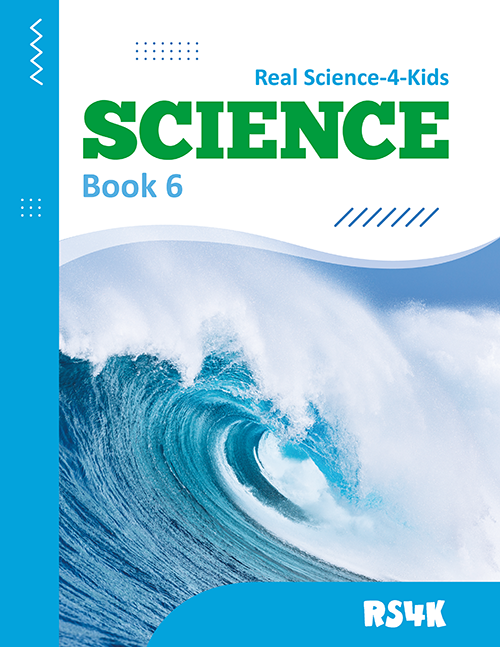


Science Book 6: The Tools That Turn Theory Into Discovery
The Year Students Learn How Scientists Know
Grades 6 to 8 · Full-year program · 22 chapters · Lesson plans and answer keys included · No science background required
Trusted by homeschool families, co-ops, and charter school classrooms.
Science Book 6 gives your family a complete year of real science: a full-color hardcover textbook, guided student work, and the RS4K Science Academy online, where your lesson plans and printables live and your student reads, practices, and tracks their own progress.
After the foundation of Book 5, Science Book 6 answers the question every real science learner eventually asks: "How do scientists actually know this?" Students explore the instruments, measurements, and technology that turn ideas into evidence.
Now Available: The RS4K Science Academy
The RS4K Science Academy is the online home of Science Book 6. Everything digital lives in one place, for you and for your student.
One chapter a week for 22 weeks, with a weekly guide that flags when it is catch-up time.
Your teaching materials, all in one place
- Fully planned 35 to 45 minute lessons, organized by chapter and ready to open and teach
- Student printables and clear answer keys, downloadable for every chapter
- No prep and no science background required
Your student’s own place to learn
- Their own login, with a weekly guide that keeps the whole year on pace
- Textbook audio, so developing readers reach the science without the reading level getting in the way
- Built-in quizzes, Unit Checkpoints, and a Science Readiness Check, scored as your student works, with results you can see
- MAISBY, the study buddy that answers science questions using RS4K’s own lessons, so explanations stay accurate and age-appropriate
Progress you can actually see. Your student marks each task complete as they go, and it all rolls up into one progress view for you.
Academy access is included with every digital format on this page, and sign-ins for you and your student arrive by email after you order.
Why Tools and Evidence Change Everything
Many students can repeat scientific explanations but still wonder whether science is "just facts from a book." Science Book 6 replaces that feeling with something stronger: science is a method of discovery built on measurement, tools, and reliable data.
Microscopes reveal cells. pH tools quantify chemistry. Sensors map Earth, and telescopes extend human vision into space. Tools work because atoms and molecules behave predictably, the same map students met in The Map We Never Got, and measurement is what turns ideas into evidence.
Students gain:
- A working understanding of the purpose behind each instrument, not just its name
- Real technique: careful measurement and honest data interpretation
- Evidence-based reasoning they can defend
- The skill and confidence that Book 7’s integration depends on
When students see how evidence is gathered, science stops being words in a book.
Want the full story behind our approach? Learn Our Approach.
Who Will Thrive With Science Book 6?
Science Book 6 is designed for students who have built a solid atomic-molecular foundation and are ready to see how science works in the real world.
Important note: Book 6 assumes students are comfortable with Book 5's atomic and molecular foundation. That foundation is essential; without it, the technology and measurements won't fully make sense.
Perfect for students who
- Have successfully completed Science Book 5 and understand atoms, molecules, bonding, and reactions
- Are curious about how scientists measure, analyze, and make discoveries
- Enjoy hands-on learning and want to understand the tools behind experiments
- Are preparing for Science Book 7 and want to strengthen practical scientific skills
Typical progression
- After completing Book 5 (natural next step)
- Grade 6: for advanced readers
- Grade 7: with support and a solid Book 5 background
- Grade 8: reads and works independently
- Students who want the essential bridge into Book 7's advanced integration
Grade Range: Grades 6 to 8, a spectrum by reading ability
Reading Level: Grade 6 for advanced readers, Grade 8 for independent work
Prerequisite: Strong understanding of Science Book 5 concepts
Focus: Scientific technology, measurement, and evidence
Open and Go, Everything Is Ready
Science Book 6 is designed to be picked up and taught immediately. No prep work, no science background required.
What a week looks like
- Open the week's lesson in the Science Academy, already planned for you
- Teach 35 to 45 minutes, then run the activity together
- Your student reads, practices, and takes the chapter quiz in their own portal
- Get up and running fast with the Quick-Start Guide.
- Understand why starting with the atomic map matters on the Start with the Right Map page.
What's Inside the 3-Book Trio
(Hardcover Student Textbook + Student Pages + Teacher Pages)
1. Hardcover Student Textbook (for your student)
A chapter-by-chapter exploration of the real tools scientists use to investigate the principles students learned in Book 5. This is the "behind-the-scenes" view of how discovery works across chemistry, biology, physics, geology, and astronomy.
2. Softcover Student Pages (for your student)
Application-focused workbooks that translate theory into practice:
- Study pages connecting atomic theory to measurement technology
- RATATAZ experiments emphasizing technique and observation
- Quizzes assessing both what we know and how we know it
- Activities designed to build technical confidence
3. Softcover Teacher Pages (for you)
Comprehensive support for guiding the transition from theory to practice:
- Lesson plans that highlight the "how" behind the "what"
- Experiment notes emphasizing proper method and data interpretation
- Answer keys explaining the technological reasoning
- Pacing guidance that supports hands-on discovery
The print trio is complete on its own. Families who prefer screen-free science need nothing digital: every lesson plan, student worksheet, and answer key is in these three books, printed and ready the day the box arrives.
Hands-On Investigations Included
Every experiment is designed to build scientific skill and show how tools make discovery possible.
A few favorites from Book 6:
- Indicator Investigators: The Magic of Red Cabbage!
- Zoom In: Adventures with the Microscope
- Pendulums in Motion
- Starlight Shadows: Navigating with Constellations
Access experiments three ways
- In the Student Pages: instructions and worksheets for applying techniques
- In the Teacher Pages: guidance on methodology and data analysis
- In the Experiment Hub: Download Experiments
22 Chapters: Using Tools to Discover the Atomic World
Every discipline, explored through the instruments that make its discoveries possible:
- Chemistry: the lab itself, glassware, balances, indicators, pH, and the chemistry of food
- Biology: microscopes from light to electron, and the living world they reveal
- Physics: measuring inertia, friction, momentum, speed, velocity, and acceleration
- Geology: from rock hammers to satellites, studying a planet-sized lab
- Astronomy: telescopes on Earth and in space, measuring across time and distance
The bridge between Book 5's foundation and Book 7's integration: understanding becomes capability.
Available Formats
Most families choose the 3-Book Trio + RS4K Science Academy. Screen-free families choose the print trio alone.
3-Book Trio + RS4K Science Academy (Recommended)
Print books plus the complete online Academy: your lesson plans and printables, and your student’s own learning portal, 18-month access
Ideal for blended print and digital instruction
3-Book Print Trio (Textbook + Student + Teacher Pages)
Hardcover Textbook + Print Student Pages + Print Teacher Pages
Ideal for hands-on, screen-free exploration of scientific tools and techniques
RS4K Science Academy (Digital Only)
The complete online Academy: your lesson plans and printables, and your student’s own learning portal, 18-month access
Ideal for digital-first instruction
Hardcover Textbook Only
Full-color print reference for reading, review, and study
Teaching more than one student? Each child does their best work in their own pages. Extra Student Pages and Teacher Pages are sold separately, in print or digital download, for siblings, co-ops, and classrooms.
Your Next Step in the Series
Completed Science Book 5 and feel confident with atoms, molecules, bonding, and reactions? Science Book 6 is the logical next step, the year students learn how scientists measure the atomic and molecular world.
Not sure the Book 5 foundation is solid yet? Review Book 5 first. Book 6 depends on that understanding.
Looking ahead? After Book 6, students continue to Science Book 7, where concepts integrate at an advanced level. Book 6 is the critical preparation that builds skill and confidence for that step.
Want to see the investigations in action? Visit the Experiment Hub to download experiments.
Prefer one order for the whole middle school sequence? See the Middle School Set covering Books 4 to 7, or the Science Home Library for the complete series.
Where to start: Science Book 6 spans Grades 6 to 8, with Grade 6 for advanced readers and Grade 8 fully independent. A solid Book 5 foundation comes first. See our Curricula Map to find the best starting point for your student.
Explore the Complete Real Science-4-Kids Science Series
Each book in the series builds on the last. Explore all books and their companion materials below:
Science Book 1
Science Book 1 Textbook Science Book 1 Student Pages Science Book 1 Teacher Pages
Science Book 2
Science Book 2 Textbook Science Book 2 Student Pages Science Book 2 Teacher Pages
Science Book 3
Science Book 3 Textbook Science Book 3 Student Pages Science Book 3 Teacher Pages
Science Book 4
Science Book 4 Textbook Science Book 4 Student Pages Science Book 4 Teacher Pages
Science Book 5
Science Book 5 Textbook Science Book 5 Student Pages Science Book 5 Teacher Pages
Science Book 6
Science Book 6 Textbook (this page) | Science Book 6 Student Pages Science Book 6 Teacher Pages
Science Book 7
Science Book 7 Textbook Science Book 7 Student Pages Science Book 7 Teacher Pages
Real Science-4-Kids® · Real explanations from atoms to astronomy, Grades K to 8
© 2026 Dr. Rebecca Woodbury, PhD, M.Ed. All rights reserved. Published under license by Gravitas Publications, Inc. Real Science-4-Kids® is a registered trademark of Gravitas Publications, Inc.
