
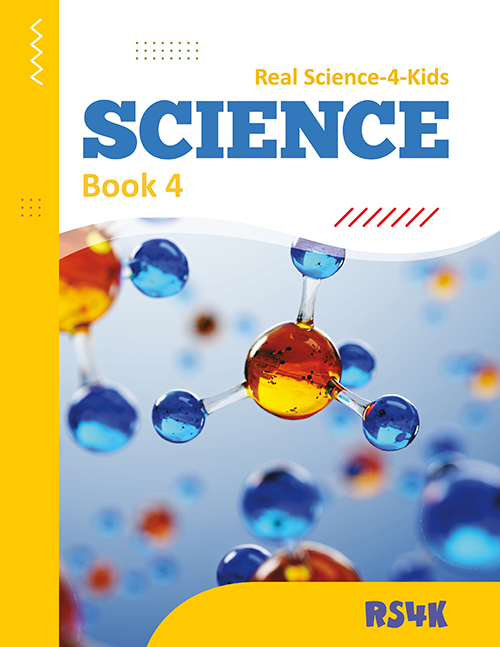


Science Book 4: From Atomic Behavior to Complex Systems
The Year Science Becomes One Connected System
Grades 4 to 6 · Full-year program · 22 chapters · Lesson plans and answer keys included · No science background required
Trusted by homeschool families, co-ops, and charter school classrooms.
Science Book 4 gives your family a complete year of real science: a full-color hardcover textbook, guided student work, and the RS4K Science Academy online, where your lesson plans and printables live and your student reads, practices, and tracks their own progress.
After seeing connections everywhere in Book 3, students are ready for something deeper: Science Book 4 teaches them how interactions at one level create behavior at another, from electrons to ecosystems to exploration in space.
Now Available: The RS4K Science Academy
The RS4K Science Academy is the online home of Science Book 4. Everything digital lives in one place, for you and for your student.
One chapter a week for 22 weeks, with a weekly guide that flags when it is catch-up time.
Your teaching materials, all in one place
- Fully planned 35 to 45 minute lessons, organized by chapter and ready to open and teach
- Student printables and clear answer keys, downloadable for every chapter
- No prep and no science background required
Your student’s own place to learn
- Their own login, with a weekly guide that keeps the whole year on pace
- Textbook audio, so developing readers reach the science without the reading level getting in the way
- Built-in quizzes, Unit Checkpoints, and a Science Readiness Check, scored as your student works, with results you can see
- MAISBY, the study buddy that answers science questions using RS4K’s own lessons, so explanations stay accurate and age-appropriate
Progress you can actually see. Your student marks each task complete as they go, and it all rolls up into one progress view for you.
Academy access is included with every digital format on this page, and sign-ins for you and your student arrive by email after you order.
Why Systems Thinking Changes Everything
Recognizing connections is powerful. Understanding systems changes how students think. Science Book 4 moves students from seeing that things are connected to understanding how interactions at one level create behavior at another.
It builds on the map students met in The Map We Never Got: a small set of ideas, structure, interaction, flow, and scale, organizes everything in nature, from chemical bonds to cosmic exploration.
Students gain:
- The ability to track energy, matter, and information through a system
- Pattern recognition that carries across all five disciplines
- Predictive thinking: how does a system respond when something changes?
- A framework for explaining complexity instead of being overwhelmed by it
Science stops feeling like a list of topics and starts feeling like the structure of reality.
Want the full story behind our approach? Learn Our Approach.
Who Will Thrive With Science Book 4?
Science Book 4 is designed for students ready to think in interacting layers of organization.
Perfect for students who
- Are ready to move from individual connections to system-level understanding
- Are curious about how energy, matter, and information flow
- Enjoy recognizing patterns and structure across disciplines
- Are prepared for deeper scientific reasoning and complexity
Typical progression
- After completing Book 3 (natural next step)
- Grade 4: reads along with you, with adult support
- Grade 5: shares more of the reading as confidence grows
- Grade 6: reads and works independently
- Students who want to understand how science organizes reality
Grade Range: Grades 4 to 6, a spectrum by reading ability
Reading Level: Grade 4 assisted reading, Grade 6 independent reading
Prerequisite: Books 1 to 3 (or equivalent foundation)
Focus: Scientific systems and scale integration
Open and Go, Everything Is Ready
Science Book 4 is designed to be picked up and taught immediately. No prep work, no science background required.
What a week looks like
- Open the week's lesson in the Science Academy, already planned for you
- Teach 35 to 45 minutes, then run the activity together
- Your student reads, practices, and takes the chapter quiz in their own portal
- Get up and running fast with the Quick-Start Guide.
- Understand why starting with the atomic map matters on the Start with the Right Map page.
What's Inside the 3-Book Trio
(Hardcover Student Textbook + Student Pages + Teacher Pages)
1. Hardcover Student Textbook (for your student)
A full-color exploration of how atomic principles create systems at every scale. Each chapter reveals how interactions between parts produce organized behavior, from chemical bonding and wave motion to ecosystems and space exploration.
2. Softcover Student Pages (for your student)
Systems-focused notebooks that develop analytical and pattern-recognition skills:
- Study pages connecting multiple levels of organization
- RATATAZ experiments demonstrating system interactions
- Quizzes assessing understanding of relationships and flows
- Activities designed to build systems thinking
3. Softcover Teacher Pages (for you)
Comprehensive support for teaching systems science:
- Lesson plans emphasizing interactions and scale
- Experiment notes highlighting system-level effects
- Answer keys explaining systemic relationships
- Pacing guidance that allows time for pattern recognition
The print trio is complete on its own. Families who prefer screen-free science need nothing digital: every lesson plan, student worksheet, and answer key is in these three books, printed and ready the day the box arrives.
Hands-On Investigations Included
Every experiment reinforces systems thinking by showing how interactions and flows create observable outcomes.
A few favorites from Book 4:
- The Electron Hotel
- Water Music Board
- Battle for the Ecosystem Game
- Tough Tardigrades: Space Survivors on a Slide
Access experiments three ways
- In the Student Pages: complete instructions and worksheets
- In the Teacher Pages: enhanced notes and safety guidance
- In the Experiment Hub: Download Experiments
22 Chapters: Seeing Science as Interacting Systems
Five disciplines, one way of thinking: parts, interactions, and the behavior they create together:
- Chemistry: bonding, states of matter, reaction rates, and heat
- Biology: the animal kingdom from invertebrates to vertebrates as organized systems
- Physics: waves, sound, light, and optics as energy in motion
- Geology: Earth's cycles, ecology, natural resources, and environmental change
- Astronomy: exploring the universe, cosmic scale, and the search for life
This is the groundwork for the full integration students reach in Books 5 through 7.
Available Formats
Most families choose the 3-Book Trio + RS4K Science Academy. Screen-free families choose the print trio alone.
3-Book Trio + RS4K Science Academy (Recommended)
Print books plus the complete online Academy: your lesson plans and printables, and your student’s own learning portal, 18-month access
Ideal for blended print and digital instruction
3-Book Print Trio (Textbook + Student + Teacher Pages)
Hardcover Textbook + Print Student Pages + Print Teacher Pages
Ideal for hands-on, systems-based learning
RS4K Science Academy (Digital Only)
The complete online Academy: your lesson plans and printables, and your student’s own learning portal, 18-month access
Ideal for digital-first instruction
Hardcover Textbook Only
Full-color print reference focused on systems and scale
Teaching more than one student? Each child does their best work in their own pages. Extra Student Pages and Teacher Pages are sold separately, in print or digital download, for siblings, co-ops, and classrooms.
Your Next Step in the Series
Completed Science Book 3? Science Book 4 teaches students how science operates through interacting systems across scales.
After mastering systems thinking, students are ready for Science Book 5, where everything comes together through full scientific integration and synthesis.
Need the foundation first? Start with Science Book 1 to establish the atomic map that supports the entire series.
Want to see the investigations in action? Visit the Experiment Hub to download experiments.
Looking ahead to the middle school years? The Middle School Set bundles Books 4 to 7 in one order.
Where to start: Science Book 4 spans Grades 4 to 6, with Grade 4 assisted reading and Grade 6 reading and working independently. See our Curricula Map to find the best starting point for your student.
Explore the Complete Real Science-4-Kids Science Series
Each book in the series builds on the last. Explore all books and their companion materials below:
Science Book 1
Science Book 1 Textbook Science Book 1 Student Pages Science Book 1 Teacher Pages
Science Book 2
Science Book 2 Textbook Science Book 2 Student Pages Science Book 2 Teacher Pages
Science Book 3
Science Book 3 Textbook Science Book 3 Student Pages Science Book 3 Teacher Pages
Science Book 4
Science Book 4 Textbook (this page) | Science Book 4 Student Pages Science Book 4 Teacher Pages
Science Book 5
Science Book 5 Textbook Science Book 5 Student Pages Science Book 5 Teacher Pages
Science Book 6
Science Book 6 Textbook Science Book 6 Student Pages Science Book 6 Teacher Pages
Science Book 7
Science Book 7 Textbook Science Book 7 Student Pages Science Book 7 Teacher Pages
Real Science-4-Kids® · Real explanations from atoms to astronomy, Grades K to 8
© 2026 Dr. Rebecca Woodbury, PhD, M.Ed. All rights reserved. Published under license by Gravitas Publications, Inc. Real Science-4-Kids® is a registered trademark of Gravitas Publications, Inc.
