
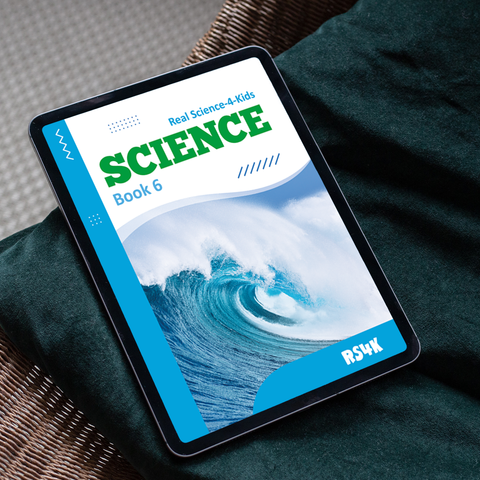

Science Book 6: The Tools That Turn Theory Into Discovery
View a sample
How Scientists Measure the Invisible World and Know What They Know
Science Book 6 is where the “Atoms First” foundation becomes tangible.
After students build a modern scientific foundation in Science Book 5, Book 6 answers the next question every real science learner eventually asks:
“How do scientists actually know this?”
This is not just another year of science content. It is a hands-on exploration of the instruments, measurements, and technologies that allow scientists to investigate atoms, molecules, cells, Earth systems, and space.
Students move from understanding the invisible world to exploring the tools that make it measurable. From microscopes that reveal cells to pH meters that quantify chemical properties, from sensors that map Earth to telescopes that extend human vision into space, Book 6 connects atomic theory directly to the technology of discovery.
This is the year science becomes practical in a new way: students learn how evidence is gathered.
Why Tools Transform Understanding
Science becomes more powerful when students understand the relationship between ideas and evidence.
Many students can repeat scientific explanations but still wonder whether science is “just facts from a book.” Book 6 replaces that feeling with something stronger: students learn that science is a method of discovery built on measurement, tools, and reliable data.
Book 6 strengthens understanding by showing students that:
-
Scientific tools extend human senses
-
Measurement turns questions into evidence
-
Technology makes invisible processes observable
-
Data makes explanations testable and trustworthy
When students see how scientists measure the world, scientific explanations stop feeling abstract. They become grounded in real evidence.
What Makes Science Book 6 Different
Science Book 6 is not simply “more experiments.” It is more scientific realism.
Students learn to:
-
Understand the purpose of scientific instruments, not just their names
-
Connect measurement tools to atomic and molecular concepts
-
Practice proper technique and data interpretation
-
See how technology supports discovery across all disciplines
-
Build readiness for the advanced integration of Science Book 7
Book 6 is the bridge between foundational theory (Book 5) and advanced synthesis (Book 7), a crucial step that turns understanding into capability.
The Tools Advantage
Turns Concepts Into Measurable Reality
Students see how atomic and molecular ideas connect to instruments that detect, measure, and verify.
Builds Evidence-Based Thinking
Students develop stronger scientific reasoning by learning how data is produced and interpreted.
Strengthens Skill and Confidence
Using real tools and techniques reinforces foundational concepts and builds readiness for advanced work.
Shows Science as a Process of Discovery
Students learn that scientific knowledge is built through method, measurement, and collaboration, not memorization.
Who Will Thrive With Science Book 6?
Science Book 6 is designed for students who have built a solid atomic-molecular foundation and are ready to see how science works in the real world.
Perfect for students who
-
Have successfully completed Science Book 5 and understand atoms, molecules, bonding, and reactions
-
Are curious about how scientists measure, analyze, and make discoveries
-
Enjoy hands-on learning and want to understand the tools behind experiments
-
Are preparing for Science Book 7 and want to strengthen practical scientific skills
Important note: Book 6 assumes students are comfortable with Book 5’s atomic and molecular foundation. That foundation is essential, without it, the technology and measurements won’t fully make sense.
Typical progression
-
After completing Book 5 (natural next step)
-
Grade 8+ independently
-
Grade 7 with strong support and a solid Book 5 background
-
Students who want the essential bridge into Book 7’s advanced integration
Reading Level: Grade 8+ for independent work
Prerequisite: Strong understanding of Science Book 5 concepts
Focus: Scientific technology, measurement, and evidence
What’s Inside the Open & Go 3-Book Set
(Hardcover Student Textbook + Student Pages + Teacher Pages)
1. Hardcover Student Textbook
A chapter-by-chapter exploration of the real tools scientists use to investigate the principles students learned in Book 5. This is the “behind-the-scenes” view of how discovery works across chemistry, biology, physics, geology, and astronomy.
2. Softcover Student Pages
Application-focused workbooks that translate theory into practice:
-
Study pages connecting atomic theory to measurement technology
-
RATATAZ experiments emphasizing technique and observation
-
Quizzes assessing both what we know and how we know it
-
Activities designed to build technical confidence
3. Softcover Teacher Pages
Comprehensive support for guiding the transition from theory to practice:
-
Lesson plans that highlight the “how” behind the “what”
-
Experiment notes emphasizing proper method and data interpretation
-
Answer keys explaining the technological reasoning
-
Pacing guidance that supports hands-on discovery
Hands-On Investigations Included
Every experiment in Science Book 6 is designed to build scientific skill and show how tools make discovery possible.
Access experiments three ways
-
In the Student Pages: instructions and worksheets for applying techniques
-
In the Teacher Pages: guidance on methodology and data analysis
-
In the Experiment Hub: https://rs4k.com/pages/experiment-hub
22 Chapters: Using Tools to Discover the Atomic World
Chapter 1: The Partnership of Science and Technology
How tools extend our senses and turn questions into answers.
Chemistry: Measuring the Molecular World (Chapters 2–5)
-
The chemistry lab: glassware, balances, and instruments
-
Acids, bases, and neutralization using indicators, pH tools, and measurement
-
Nutritional chemistry and molecular analysis of food
Students learn that chemistry is measurable because molecules behave predictably, and tools make that behavior visible.
Biology: Tools for Exploring Life (Chapters 6–9)
-
Biology labs and specialized tools across subfields
-
Microscopes from light to electron and what they reveal
-
Protists and fungi using classification tools and observation technology
Students learn that living systems become understandable when we can observe structure and function directly.
Physics: Instruments of Motion and Force (Chapters 10–13)
-
Physics tools from mathematics to large-scale research technology
-
Measuring inertia, mass, friction, momentum, speed, velocity, and acceleration
Students learn how physicists quantify motion and force—and how measurement turns physical ideas into evidence.
Geology: Technology for a Planet-Sized Lab (Chapters 14–17)
-
Geological tools from rock hammers to satellites
-
Studying Earth’s spheres through measurement and detection
-
Understanding geosphere and atmosphere through observation systems
Students learn how scientists study an entire planet using tools that detect patterns we cannot see directly.
Astronomy: Reaching for the Stars (Chapters 18–21)
-
Telescopes on Earth and in space
-
Measurement and discovery across time and distance
-
Solar systems and beyond through observational technology
Students see how astronomy becomes a science of evidence through instruments that extend human vision.
Chapter 22: Collaboration
How scientific tools enable researchers around the world to work together.
Why Families & Educators Choose Science Book 6
-
Bridges theory and practice by showing how atomic ideas are tested and measured
-
Reinforces Book 5 foundations by making atomic concepts tangible and observable
-
Builds confidence for Book 7 through practical skill development
-
Teaches science as a process grounded in evidence and method
-
Complete experiment access with hands-on investigations included
-
Strong teacher support for technique, interpretation, and pacing
Available Formats
Open & Go 3-Book Set (Recommended)
Hardcover Textbook + Print Student Pages + Print Teacher Pages
Ideal for hands-on, screen-free exploration of scientific tools and techniques
Digital Teaching Dashboard (1-Year Access)
A complete digital classroom focused on measurement, technology, and discovery
Ideal for visualizing tools, independent exploration, and classroom teaching
Hardcover Textbook Only
Full-color print reference for reading, review, and study
1-Year Digital Textbook Only
Interactive flipbook access across devices
Ideal for previewing, reference, and reinforcement
Student Pages Only
Print or PDF for additional students or replacements
Includes experiment worksheets
Teacher Pages Only
Print or PDF for co-ops, classrooms, or multiple instructors
Includes experiment guides and answer keys
Your Next Step in the Series
Completed Science Book 5 and feel confident with atoms, molecules, bonding, and reactions?
Science Book 6 is the logical next step, the year students learn how scientists measure the atomic and molecular world.
Not sure the Book 5 foundation is solid yet? Review Book 5 first. Book 6 depends on that understanding.
Looking ahead? After Book 6, students continue to Science Book 7, where concepts integrate at an advanced level. Book 6 is the critical preparation that builds skill and confidence for that step.
Want to see the investigations in action? Visit the Experiment Hub
The Tools Difference
Traditional programs may explain ideas without showing how those ideas are verified.
Science Book 6 shows students that science is built on measurement and method.
Students begin to realize:
-
Tools work because atoms and molecules behave predictably
-
Evidence comes from instruments that measure real properties
-
Data is what makes explanations reliable
-
Discovery depends on technique, not just information
When students understand the tools, they understand the process of science—and they are ready to handle advanced integration.
Science Book 6 Builds the Discovery Lens
Book 6 helps students develop:
-
Evidence-based reasoning rooted in measurement
-
Technical confidence with scientific tools and method
-
Stronger understanding of atomic concepts through application
-
Readiness for the advanced synthesis of Science Book 7
Science Book 6 doesn’t just teach science tools.
It teaches students how scientific knowledge is built.
Ready to turn theory into discovery?
Add Science Book 6 to your cart today.
Explore the Complete Real Science-4-Kids Science Series
Each book in the series builds on the last. Explore all books and their companion materials below:
Science Book 1
Science Book 1 Textbook | Science Book 1 Student Pages | Science Book 1 Teacher Pages
Science Book 2
Science Book 2 Textbook | Science Book 2 Student Pages | Science Book 2 Teacher Pages
Science Book 3
Science Book 3 Textbook | Science Book 3 Student Pages | Science Book 3 Teacher Pages
Science Book 4
Science Book 4 Textbook | Science Book 4 Student Pages | Science Book 4 Teacher Pages
Science Book 5
Science Book 5 Textbook | Science Book 5 Student Pages | Science Book 5 Teacher Pages
Science Book 6
Science Book 6 Textbook | Science Book 6 Student Pages | Science Book 6 Teacher Pages
Science Book 7
Science Book 7 Textbook | Science Book 7 Student Pages | Science Book 7 Teacher Pages