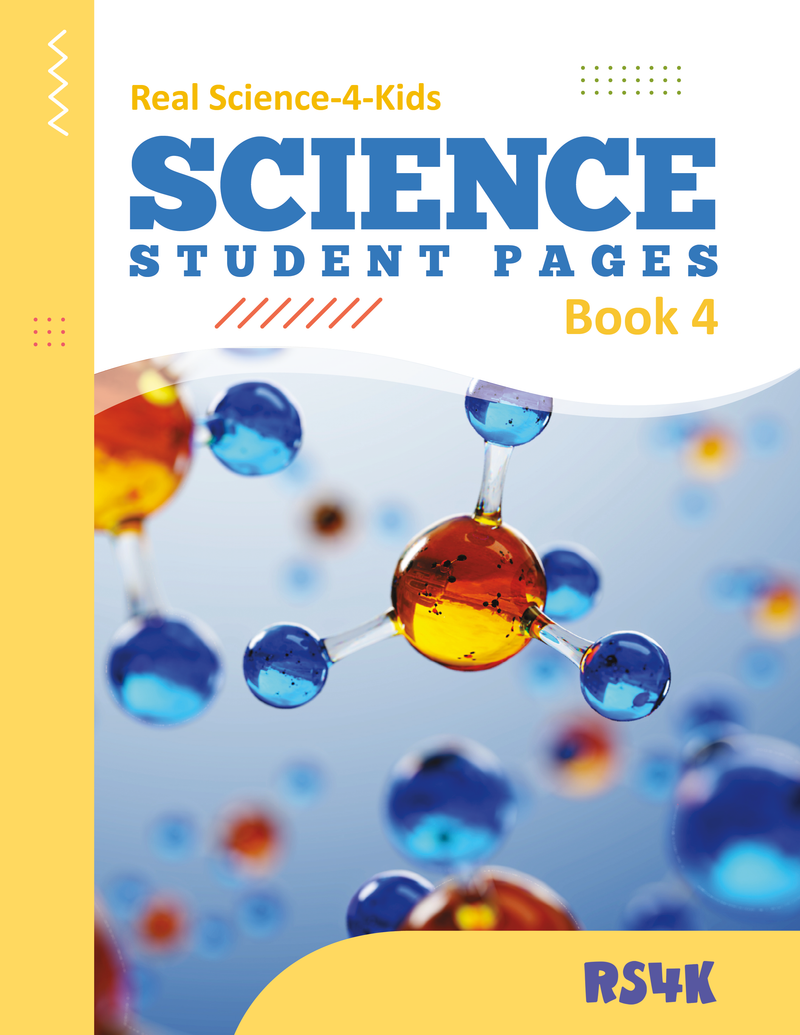

Science Book 4 — Student Pages
Seeing How Science Organizes Reality Across Scales
Science Book 4 is where the Atoms-First learning progression expands into systems thinking. After students learn the atomic map in Book 1, apply scientific tools in Book 2, and recognize real-world connections in Book 3, Book 4 helps them see something deeper.
Atomic and molecular behavior does not just explain individual phenomena. It builds chemical systems, biological systems, ecological systems, Earth systems, and even exploration systems in space.
Science Book 4 shows students how these layers fit together to organize the natural world. This is the book where students begin to understand structure, interaction, flow, and scale — the core ideas behind real scientific explanation.
From Connections to Systems
Science Book 3 teaches students to see science everywhere. Science Book 4 teaches them to see how science works together.
Students begin to recognize systems made of interacting parts, understand energy flow, cycles, and feedback, track relationships across scales from atomic to cosmic, and think predictively about how systems respond to change.
This is the stage where science stops feeling like a collection of topics and starts feeling like an organized structure of reality.
The Atoms-First Difference
Book 4 transforms how students see scientific complexity.
True Systems Thinking
Students learn to identify components, interactions, and outcomes instead of memorizing isolated facts.
Integrates Scale
Atomic, molecular, biological, ecological, planetary, and cosmic systems are studied as connected layers.
Strengthens Pattern Recognition
Students recognize repeating principles — energy transfer, structure, interaction — across disciplines.
What Makes Science Book 4 Different
From Parts to Wholes
Students learn how interactions at one level create behavior at another — the core of systems thinking.
Tracks Energy Flow
Energy, cycles, and feedback become visible tools for explaining complexity.
Prepares for Full Integration
Book 4 lays the conceptual groundwork for the complete synthesis students achieve in Science Book 5.
Who Will Thrive With Science Book 4?
Science Book 4 is designed for students ready to think in interacting layers of organization.
- After completing Book 3 (natural next step)
- Ages 10–12 with support
- Ages 12–14 independently
- Students who want to understand how science organizes reality
What’s Inside
Hardcover Student Textbook
A full-color exploration of how atomic principles create systems at every scale.
- How interactions between parts produce organized behavior
- From chemical bonding to wave motion
- From ecosystems to space exploration
- Systems thinking across all disciplines
Softcover Student Pages
Systems-focused notebooks that develop analytical skills.
- Study pages connecting multiple levels of organization
- RATATAZ experiments demonstrating system interactions
- Quizzes assessing understanding of relationships and flows
- Activities designed to build systems thinking
Softcover Teacher Pages
Comprehensive support for teaching systems science.
- Lesson plans emphasizing interactions and scale
- Experiment notes highlighting system-level effects
- Answer keys explaining systemic relationships
- Pacing guidance for pattern recognition
22 Chapters: Seeing Science as Interacting Systems
Students discover how atomic behavior creates organized systems at every scale.
From Electrons to Materials
Chemical bonding, states of matter, reaction rates, and heat — how electron behavior creates material properties.
Animal Systems and Diversity
Classification, invertebrates, arthropods, and vertebrates — how biological systems organize complexity.
Wave Systems and Energy Transfer
Wave properties, sound, light, and optics — energy and information as predictable system behaviors.
Earth’s Interconnected Systems
Atmospheric cycles, ecology, natural resources, and environmental impacts — Earth as a dynamic network.
Exploration and Cosmic Systems
Space exploration, universe scale, life detection, and future missions — system thinking beyond Earth.
Why Families & Educators Choose Science Book 4
Systems thinking — students learn to see interactions, not just facts
Scale integration — from atomic to cosmic, all connected
Pattern recognition — repeating principles across disciplines
Predictive reasoning — students think about how systems respond to change
Teacher-friendly design — complete instructional support throughout
Prepares for advanced study — essential groundwork for Science Book 5
Digital Teaching Dashboard
Everything for each chapter is one click away. Start with the Lesson Plan, use the Teacher Study Notebook (answers), print the Study Notebook and Lab Pages, then use the Quiz and Quiz Answers. Chapter resources organized across all 22 chapters with Pre-Test and Post-Test assessments included.
Explore the Digital Hub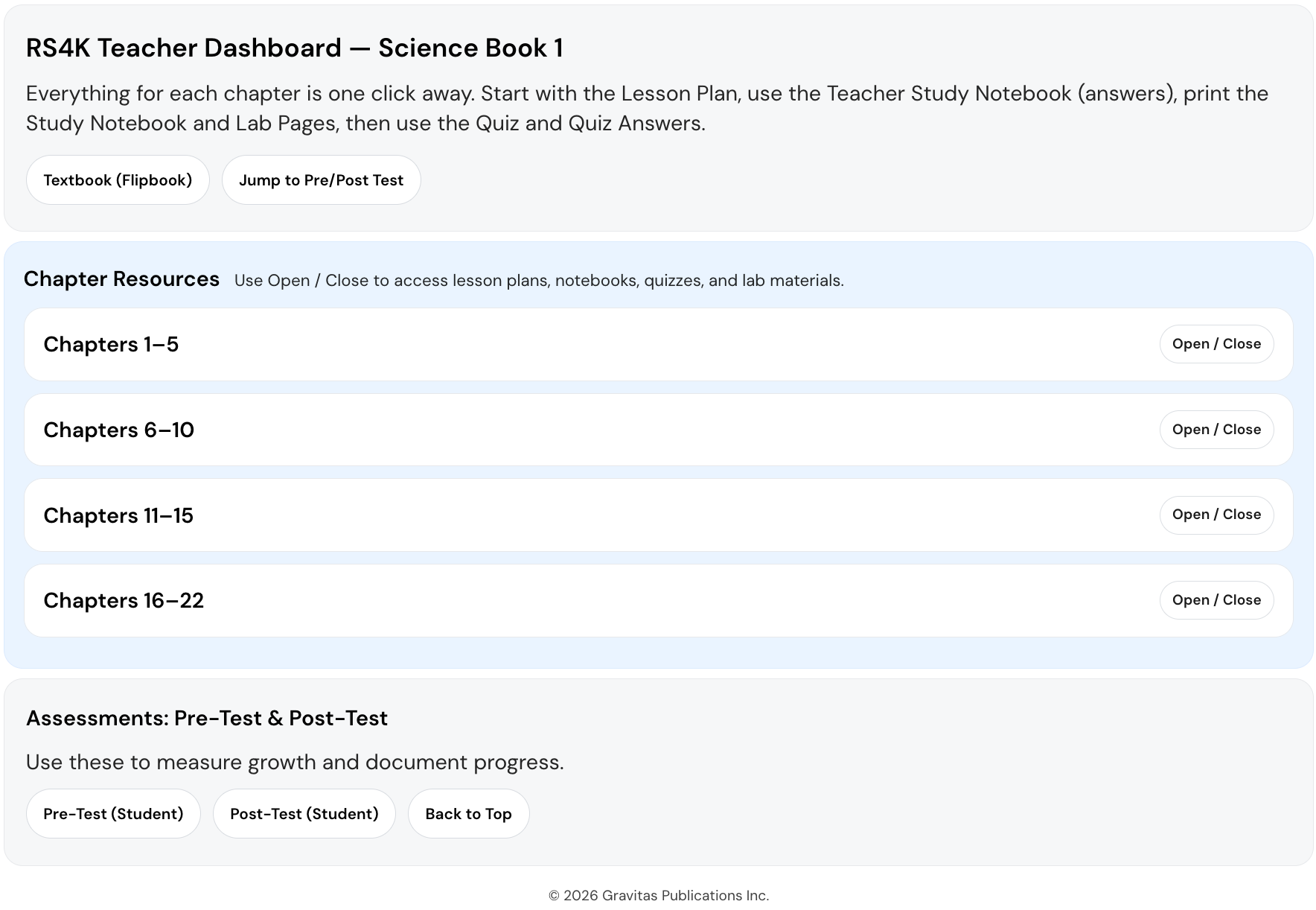
Available Formats
Open & Go 3-Book Set
Hardcover Textbook + Print Student Pages + Print Teacher Pages. Ideal for hands-on learning and family use.
Digital Teaching Dashboard
Fully organized digital classroom aligned by chapter. Ideal for blended or digital-first instruction.
Hardcover Textbook Only
Full-color print edition for reference, libraries, or supplemental use.
Digital Textbook Only
Interactive flipbook access across devices. 1-year access included.
Teaching Real Science is as Easy as 1 - 2 - 3
Read the Book
Learning science is as easy as reading a book. Just open to the first chapter and get started. No internet or online subscription needed.
Experiment
Go to the Experiment Hub and find the experiment you want your child to do. Download, print and read the teacher instructions.
Have Fun
Make a mess, explore new ideas, and let them play. Most of science is just playing and learning science is more exciting when you are involved.
Trusted by Families & Educators
Best science curriculum out there! Just wanted you to know how much I’ve appreciated teaching my kids from your materials.
As a science teacher, I’ve tried several programs, but RS4K stands out. The emphasis on authentic scientific vocabulary and age-appropriate foundational content makes it easy for my students to grasp complex concepts.
I love how RS4K introduces complex topics like atoms and molecules in an easy-to-understand manner for younger students. My daughter has developed a strong foundation in science and always looks forward to her lessons.
Your Scientific Journey Continues
After mastering systems thinking, build the modern scientific foundation.
Questions about placement? Visit our FAQ to find the best starting point for your student.