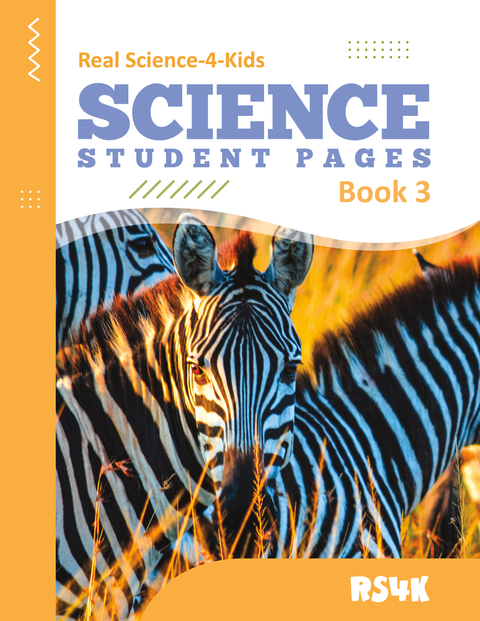
Science Book 3 — Student Pages
The Hands-On Practice for Seeing Science as One Connected Story
The Science Book 3 Student Pages are where your student’s Atoms-First journey reaches a pivotal stage: Connection. After building a correct atomic foundation (Book 1) and learning scientific methodology (Book 2), these pages provide the essential practice for seeing how atomic-molecular theory unifies all science. This interactive workbook trains students to actively connect the principles of chemistry, biology, physics, geology, and astronomy into a single, logical explanation of their world.
What’s Inside
Study Notebook Pages — Map Concepts to Reality
These activities build on the atomic framework. Through cutting, pasting, and advanced diagramming, students create visual models that explicitly link molecular structure (like polymers or DNA) to real-world function. This moves them from knowing facts to modeling how atomic theory explains everything from plant growth to electrical circuits.
Experiment Pages — Discover the Atomic "Why" Behind the "What"
Guided by the RATATAZ method (Read, Ask, Test, Answer, Talk, & Dazzle), every lab answers a core question: "What atomic or molecular behavior causes what I'm observing?" Students form hypotheses, gather evidence, and conclude by connecting tangible results, like the behavior of light or the stages of a water cycle, back to the invisible interactions of atoms and molecules.
Quiz Pages — Demonstrate Integrated, Causal Understanding
End-of-chapter assessments require students to do more than define terms. They must explain phenomena causally, demonstrating how the atomic principles established in Books 1 and 2 provide the foundation for understanding the interconnected concepts in Book 3.
How This Book Fits the Atoms-First Progression
This is the third critical step in the RS4K learning arc, where separate sciences merge into a unified understanding:
-
Book 1 (Foundation): Students learn what atoms and molecules are, the correct starting point.
-
Book 2 (Methodology): Students learn how we investigate the atomic world using scientific tools.
-
Book 3 (Connection): Here, students learn where atomic theory applies everywhere. They actively practice using their atomic lens to see the common principles in chemistry, biology, physics, geology, and astronomy.
Why These Student Pages Are a Critical Link
-
Completes the Conceptual Framework: This is where fragmented “science subjects” dissolve into one coherent story. Students achieve the “aha!” moment that atomic theory is the master key.
-
Builds Unshakeable Relevance: By linking every abstract concept to concrete, everyday examples, it permanently answers, “Why do I need to know this?” transforming student engagement.
-
Creates Prepared Thinkers for Advanced Study: The connective reasoning practiced here is the essential prerequisite for the systems thinking in Book 4. Students are not just learning more; they are learning to think more deeply.
-
Empowers Independent Exploration: Equips students with a reliable framework (atomic theory) to make sense of any new topic, building immense confidence for future learning.
Your Format Options:
-
Print Edition: Perforated, tear-out pages with cut-out activities. Perfect for building a personal “Science Connections” journal.
-
Downloadable PDF: For instant digital access and flexible printing.
The Culmination of Foundational Understanding
The Science Book 3 Student Pages are where the initial promise of the Atoms-First approach is fully realized. Students don't just complete a workbook, they compile evidence that science is one beautifully connected system, and they now hold the map. This is the confident springboard into the analytical challenges of Books 4-7.
Ready to Connect the Dots?
These pages are included in the Science Book 3 Open-and-Go 3-Book Set and as printables within the Science Book 3 Digital Teaching Dashboard.