
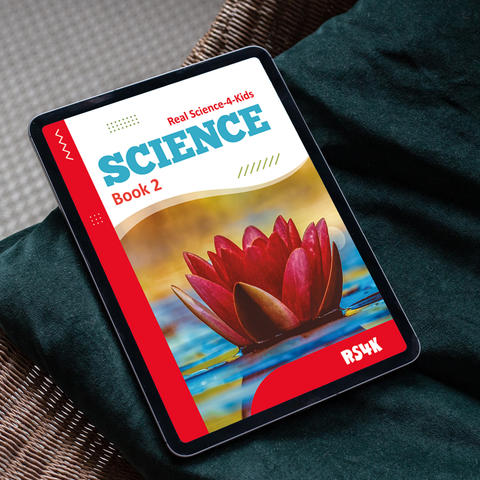

Science Book 2: The Scientific Toolkit for Independent Discovery
View a Sample
Applying the Atomic Map with Real Scientific Methods
Now that your student has the right map, the atomic framework introduced in Science Book 1, Science Book 2 provides the tools needed to navigate it. This book introduces the real methods, instruments, and thinking processes scientists use to investigate the natural world.
Science Book 2 is where atomic theory meets hands-on investigation. Students move beyond reading about science and begin doing science, learning how evidence is gathered, analyzed, and used to build reliable knowledge. The result is a confident learner who understands not only what scientists know, but how they know it.
From Map to Method: The Next Step in Scientific Thinking
Science Book 1 gave students the atomic map that connects all scientific disciplines. Science Book 2 teaches students how to use that map. See The Map We Never Got to learn more.
Each major scientific discipline, chemistry, biology, physics, geology, and astronomy, has its own dedicated Toolbox chapter. In these chapters, students learn the actual tools and practices used by scientists, including observation, measurement, classification, experimentation, modeling, calculation, and prediction.
Rather than treating scientific methods as abstract ideas, Book 2 embeds them directly into meaningful investigations. Students see how different disciplines ask different questions, use different tools, and yet all investigate the same atomic reality.
Why Methodology Matters
Memorizing scientific facts does not create scientific understanding. True scientific literacy comes from knowing how knowledge is discovered, tested, and verified.
Science Book 2 bridges the gap between what we know and how we know it. Students learn that scientific knowledge is not handed down as finished answers, but built through careful observation, controlled experimentation, and logical reasoning, all grounded in the atomic framework established in Book 1. See The Map We Never Got to learn more.
This approach builds deep understanding, critical thinking, and long-term retention while preparing students for advanced science study.
The Scientific Toolkit Advantage
Professional Methodologies Introduced
Students do not just learn science topics, they learn to think and work like scientists. Each discipline introduces its own professional tools, instruments, and reasoning strategies.
Applies the Atomic Map to Investigation
Every experiment and observation connects back to atomic theory, showing how scientific methods reveal atomic principles in action.
Builds Analytical Independence
Students transition from following instructions to designing investigations, making measurements, analyzing results, and drawing evidence-based conclusions.
Connects Disciplines Through Methodology
Students discover how different sciences use related tools and thinking processes to investigate the same physical reality.
Who Should Use Science Book 2?
Science Book 2 is designed for students who are ready to apply their atomic foundation through systematic investigation.
Ideal Progression
-
After completing Science Book 1 (direct continuation of the curriculum)
-
Ages 8–10 with guidance
-
Ages 10–12 working independently
-
Students with prior science exposure who need strong methodology and structure
Reading Level: Approximately Grade 4+ for independent work
Prerequisite: Science Book 1 or a comparable atomic framework foundation
Focus Shift: From understanding concepts to applying scientific methods
What’s Inside the Open & Go 3-Book Set
(Hardcover Student Textbook + Student Pages + Teacher Pages)
1. Hardcover Student Textbook
A guided journey through the five scientific disciplines, each introduced through its professional Toolbox. Students explore:
-
The Chemist’s Toolbox: measurement, mixing, analysis
-
The Biologist’s Toolbox: observation, classification, microscopy
-
The Physicist’s Toolbox: measurement, calculation, prediction
-
The Geologist’s Toolbox: fieldwork, analysis, modeling
-
The Astronomer’s Toolbox: observation, measurement, calculation
-
How all methodologies connect through the atomic framework
2. Softcover Student Pages
Hands-on workbooks designed to build investigative skill and scientific reasoning:
-
Study pages focused on tools and methods
-
RATATAZ experiments emphasizing careful observation and measurement
-
Quizzes assessing both content knowledge and process understanding
-
Activities structured to build methodological confidence
3. Softcover Teacher Pages
Complete instructional support for guiding real scientific inquiry:
-
Lesson plans emphasizing process, not rote answers
-
Experiment notes with safety guidance and teaching tips
-
Answer keys with explanations of scientific reasoning
-
Pacing guidance for thoughtful investigation
Hands-On Investigations Included
Every experiment in Science Book 2 is methodology-focused, teaching students how scientists actually gather and evaluate evidence.
Access experiments three ways
-
In the Student Pages: step-by-step instructions and data sheets
-
In the Teacher Pages: expanded notes and safety guidance
-
In the Experiment Hub: Download Experiments
22 Chapters: Mastering the Scientific Toolkits
Introduction: The Tools of Science
How scientists across disciplines share common methodological principles.
Chemistry: The Chemist’s Toolbox
Measurement and mixing, acids and bases, chemical reactions, and food chemistry—showing how molecular structure affects flavor and digestion.
Biology: The Biologist’s Toolbox
Observation and classification, microscopic life, energy transfer in feeding protists, and fungal diversity including molds, mushrooms, and yeasts.
Physics: The Physicist’s Toolbox
Measurement and calculation, motion initiation, linear motion, and curved and circular paths.
Geology: The Geologist’s Toolbox
Fieldwork techniques, Earth’s interconnected spheres, the geosphere, and atmospheric science.
Astronomy: The Astronomer’s Toolbox
Observation and calculation, constellations, solar system dynamics, and deep-space phenomena.
Conclusion: Synthesizing Methodologies
How different scientific tools work together to investigate the same atomic reality.
Why Families & Educators Choose Science Book 2
-
Methodology-based learning that reflects real scientific practice
-
Sequential “Atoms First” foundation continuing directly from Book 1
-
Comprehensive experiment access with all labs included
-
Cross-disciplinary connections that unify science learning
-
Analytical skill development beyond memorization
-
Strong instructional support for parents and teachers
-
Preparation for advanced study through real scientific thinking
Available Formats
Open & Go 3-Book Set (Recommended)
Hardcover Textbook + Print Student Pages + Print Teacher Pages
Ideal for hands-on learning and family investigation
Digital Teaching Dashboard (1-Year Access)
A fully organized digital classroom focused on scientific methodology
Ideal for blended or digital-first instruction
Hardcover Textbook Only
A full-color reference focused on scientific tools and methods
1-Year Digital Textbook Only
Interactive flipbook access across devices
Student Pages Only
Print or PDF for additional students or replacement materials
Teacher Pages Only
Print or PDF for co-ops, classrooms, or multiple instructors
Your Scientific Journey Continues
-
Continue to Science Book 3 to explore matter states and biological systems
-
Advance to Science Book 4 for chemistry, physics, and geology connections
-
Progress to Science Book 5 for comprehensive scientific integration
The Methodology Difference
Traditional science programs focus on memorizing facts.
Science Book 2 teaches students how scientific knowledge is built.
Students learn to:
-
Use real scientific tools
-
Connect evidence to atomic theory
-
Think critically and independently
-
Build confidence through hands-on investigation
“First we give them the map. Then we teach them to navigate.”
See The Map We Never Got to learn more.
Science Book 2 doesn’t just teach science, it teaches students how to do science.
Ready to equip your student with real scientific tools?
Add Science Book 2 to your cart today.
View a Sample
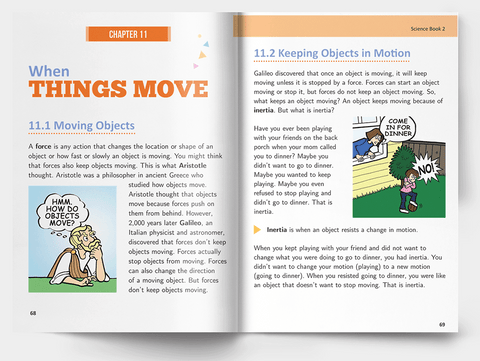
Force, Energy, & Inertia
In Book 2, students are introduced not only to force & energy, but also inertia - which keeps things moving. With our program students build foundational knowledge that will last a lifetime.
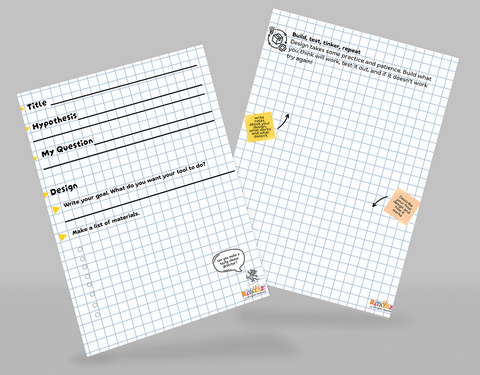
Create, Explore, Design
Head over to our Experiment Hub where students learn the scientific method, engineering & design principles, and problem solving with our free activities. Just download & print!
1 - 2 - 3 Simple Steps to Science
Your child's science learning begins with chapter one. Just open the book and have them begin reading. No subscription fees, technology set up, or internet necessary.
Find the Perfect ExperimentBrowse through our Experiment Hub to find one that captures their imagination. Students engage in direct-instructional experiments, design projects, and more. Just download, print and let the fun begin.
The Power of PlayJoin your child while they learn science and reinforce the idea that play is crucial in learning science. Encourage your child to explore and experiment.

Notes From Our Fans

RS4K's curriculum structure is excellent. It systematically covers chemistry, physics, biology, astronomy, and geology,
ensuring that students build their knowledge step by step. My son is more confident in his science skills now, thanks to this program.

The thoroughness of RS4K's curriculum is unparalleled.
It goes beyond superficial NGSS alignment to offer a comprehensive and accurate understanding of science. My students love the hands-on experiments and
engaging content.